

Weatherguard NWA · An insulation contractor, findable in every city it serves
A family-owned insulation contractor, found in every city it serves, with a lead form checked every day.

- Client Visit site
 Weatherguard NWA
- Industry Insulation contractor · Spray foam, blown-in fiberglass, and crawl space encapsulation
- Location
- Service lines
Services rendered
- Website rebuilt from WordPress, with every legacy URL kept or redirected
- Service pages for spray foam, blown-in fiberglass, and crawl space encapsulation, with spoke pages beneath them
- City pages across Northwest Arkansas, plus service-by-city pages written for each town
- Business, service, FAQ, and breadcrumb structured data on every template
- Four-field estimate form with spam screening, email delivery, and a backup archive
- Daily automated check that submits the live form and confirms it arrives
- Sanity Studio with on-page visual editing and validation that mirrors the build checks
- Google Analytics events for call taps and estimate requests
- Astro
- Sanity
- Netlify
- Netlify Functions
- SendGrid
- GitHub Actions
- Google Analytics 4
- Structured data
What changed.
- Page titlesBefore
A product name and the brand, with no service and no city
AfterService and city named in the title, one page per search
- Legacy addressesBefore
Old WordPress URLs, some of them stray pages with no content
AfterEvery old address resolves to a live page or a redirect
- Knowing what worksBefore
No analytics tag on the old site
AfterCall taps and estimate requests tracked as events
Where the decisions live.
Each waypoint marks one choice we made for this audience and why it earned its place.
Right trade, wrong search results.
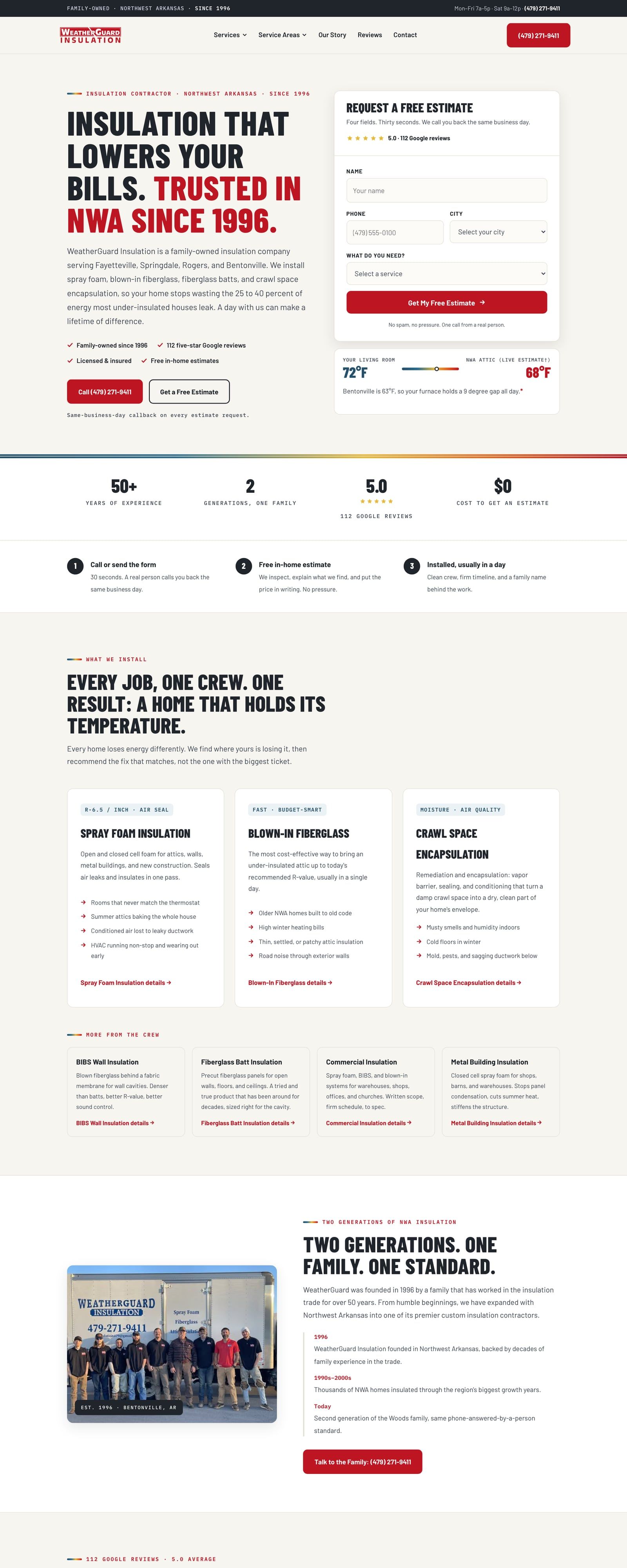
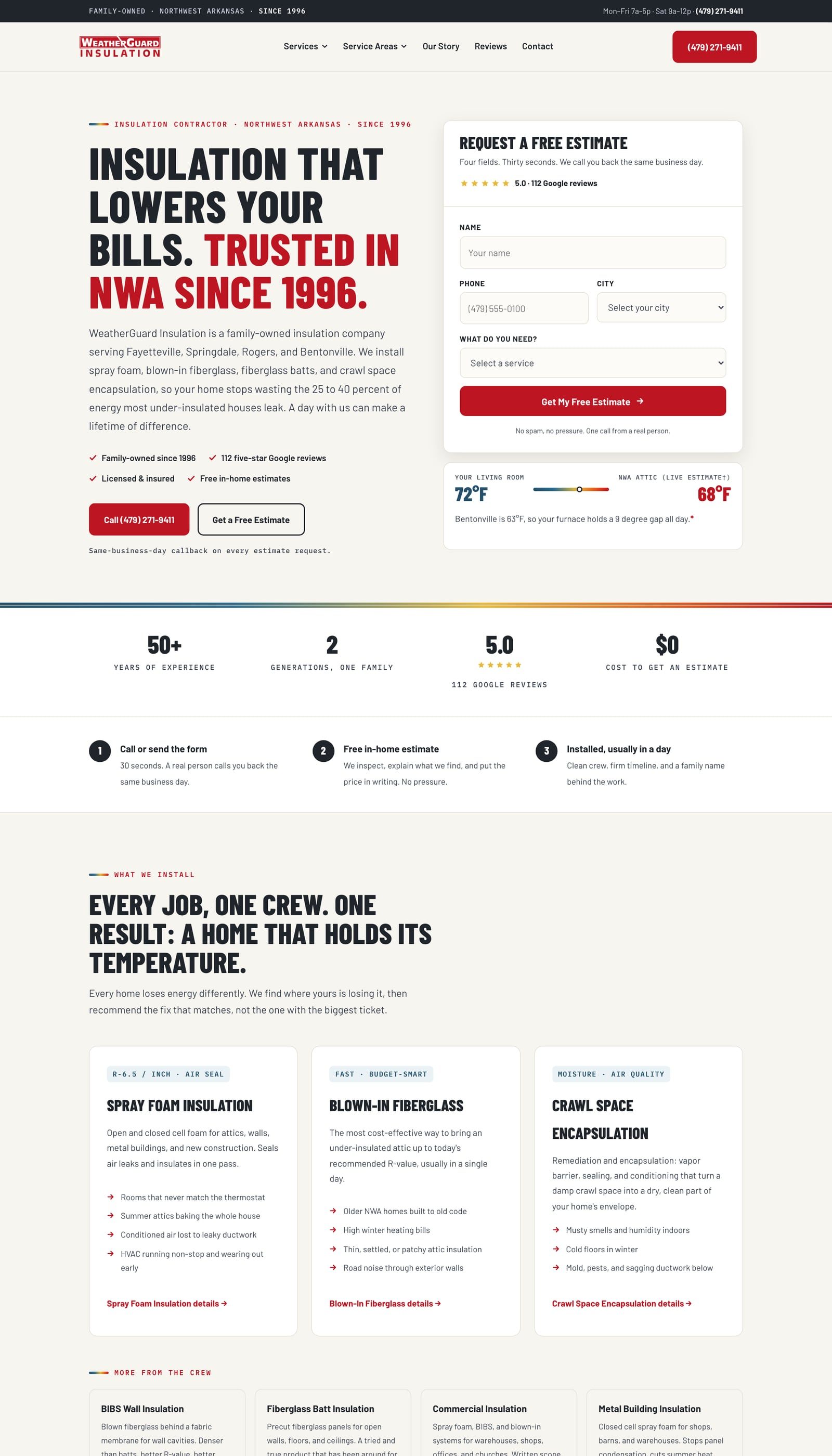
Weatherguard NWA is a family-owned insulation contractor in Bentonville. The crew installs spray foam, blown-in fiberglass, and crawl space encapsulation for homes and buildings across Northwest Arkansas. Homeowners shop for that work by service and by town, so the business had to be the answer to both questions.
The WordPress site it had could not give that answer. Page titles carried a product name and the brand but no service and no city, the words Northwest Arkansas appeared mostly in the footer, and a few stray pages had no real content at all. One wall insulation page was quietly earning search rankings that a careless redesign would have thrown away.
The brief was a site that earns the first phone call: a form short enough to finish on a phone in a driveway, the number one tap away, and proof that every request reaches a person. In a trade business, a lead that goes missing is money lost.
One hub, many doors.
We started with how people search, not with a layout. Three service hubs, one each for spray foam, blown-in fiberglass, and crawl space encapsulation, answer what the work fixes, what installation looks like, and what drives the price. Spoke pages sit beneath them for wall insulation, fiberglass batts, commercial work, and metal buildings. The wall insulation page that already ranked kept its original address and became a full spoke, so its standing carried over.
Then the map. Every city the crew serves gets its own page, and the four anchor cities also get a page for each core service. Each one is written from that town's housing, neighborhoods, and common problems rather than swapped into a template, so no two read as copies. Navigation, footer links, and city grids read from Sanity, which makes adding a town a content task instead of a rebuild. Business, service, FAQ, and breadcrumb structured data ride on every template, and each FAQ is specific to its service or city.
The estimate form asks four things. Behind it, our own function screens for spam, emails the request through SendGrid, and files a backup copy in Netlify Forms, so one failing channel cannot lose a lead. If both fail, the visitor sees the phone number instead of an error. Every morning an automated check submits the live form as a test visitor, follows it to the thank-you page, and flags us if any step breaks.
The homepage also does one thing a template would not. It reads the day's real temperature from the National Weather Service and shows an estimated attic temperature beside the living room, with a static version as the fallback. Everything else is static pages with an inlined stylesheet and analytics that load after the page does, which is how the speed scores stayed high. A build step fails on missing titles, duplicate headings, broken internal links, and a changed phone number before anything ships.
4 phases, this engagement.
Every engagement has its own arc. Here is what shipped, in order, for this one.
- 01
Audit and brief
A review of the old site and the local search results city by city, then design and search briefs that set the page map.
- 02
Concept
A full homepage concept approved before any build, then matched component for component.
- 03
Build and content
Astro templates, Sanity content for every service and city, a redirect map, and build checks that fail on broken rules.
- 04
Launch and watch
DailyCutover on the client's domain with the old host held as a rollback, then a daily check on the lead form.
Fast, findable, and watched.
The site went live on the client's own domain with every address from the old sitemap resolving to a live page or a redirect to its closest equivalent. At launch, PageSpeed scores were 96 on mobile and 100 on desktop.
Weatherguard NWA now has a page for each service, each city, and each pairing worth ranking for, a form that is tested daily, and call taps and estimate requests measured as events in Google Analytics. Search results take time to arrive, and the measurement is in place so the next chapter can be written from the numbers.


Keep exploring the work.
Let’s build yours next.
Score your site in three minutes for an honest read. Or have us audit it in five business days. No deck, no pitch, no obligation.